
They Said It Was Perimenopause. It Was MS. Here's My Diagnosis Story
This blog post may contain affiliate links. I earn a small commission from your purchase without any charge to you
I need you to stay with me here, because this story takes some turns.
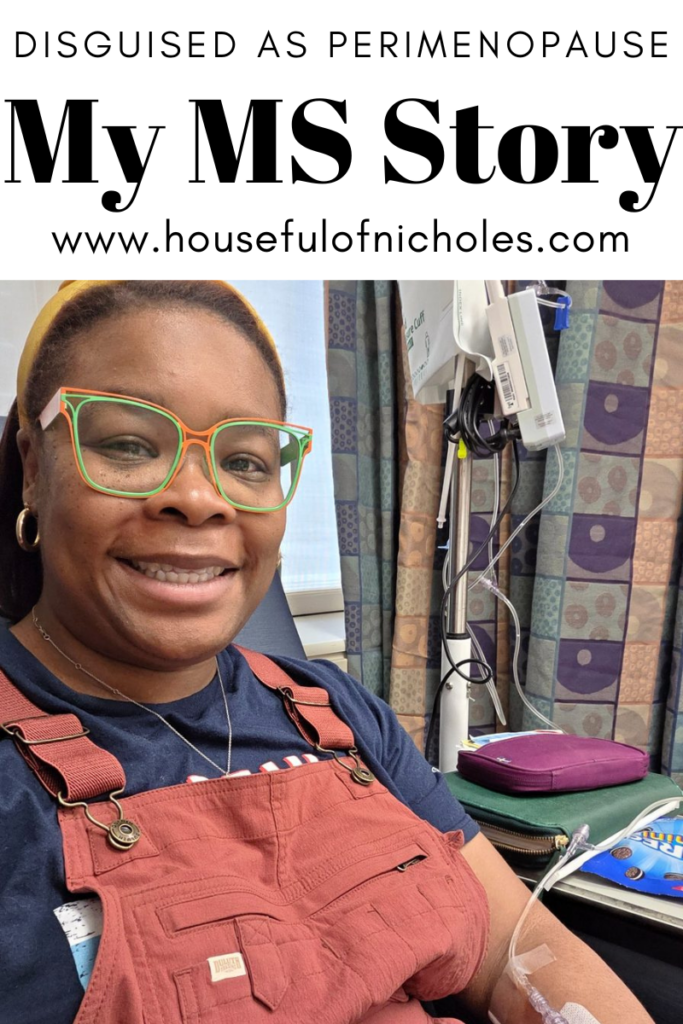
It started with lactation. Not a baby. I am well past that chapter. Remember, I had my uterus removed in 2019. Just my body, in the thick of perimenopause, deciding that it would start to randomly produce milk. Which, if you know anything about perimenopause, you know that it is essentially your hormones doing whatever they want with zero regard for your comfort or your logic. So I mentioned it to my gynecologist. She took it seriously, the way good doctors do, and ordered imaging to check my pituitary gland, the small gland at the base of my brain that regulates hormones and can, if something is growing on it, cause unexpected lactation.
What she found on that imaging wasn't a pituitary tumor.
It was lesions. On my brain. And on my spinal column.
And that is how I found out, in October 2025, that I have Multiple Sclerosis.
Six Years Before...
Here's what I want you to understand about the six years leading up to October 2025: I was not ignoring my body. I was explaining it. There's a difference, and it matters.
The fatigue that settled into my bones and wouldn't leave. I had lost people I loved. Grief does that. The brain fog made me reach for words I'd always had easy access to. I was running an organization, managing a family, holding a lot. Of course, my brain was tired. The numbness and tingling that showed up in my hands and feet were due to perimenopause. Everything was perimenopause. My body was changing; I was in my 40s, and this was what that looked like.
The balance issues that crept in. I chalked those up to not sleeping enough, not eating consistently enough, and doing too much. Which, fair. I do a lot. I always have.
None of those explanations was unreasonable. That's the thing I've had to sit with. Every single one of them made sense given my life and my circumstances. I wasn't being careless. I was a Black woman in America who had been trained, by necessity, to push through, rationalize, and keep moving.
My body was talking. I just didn't know what language it was speaking yet.
What Nobody Tells You About MS and Black Women
When the word "MS" entered my world, my first thought was genuinely: that's not something I get. Because that's what I had absorbed, somewhere along the way, that MS was another demographic's disease. Younger. European ancestry. Not me. Christina Applegate. Selma Blair.
That is a lie that the medical community has been slowly, insufficiently correcting for years. Black women actually have a higher risk of developing MS than white women. We tend to be diagnosed later, with more progression already underway, because nobody was looking for it in us. A Black woman comes in talking about fatigue, numbness, and brain fog, and the differential diagnosis list that forms in a doctor's mind often doesn't put MS at the top.
It took a random lactation symptom and a gynecologist thorough enough to order a brain MRI for my diagnosis to happen. Not a neurologist. Not a symptom that was impossible to explain away. A pituitary check.
I don't know whether to laugh or cry about that, honestly. Some days I want to do both.
What Happened After the Images Came Back
My gynecologist didn't panic. She was measured and clear, and she immediately referred me to a neurologist. The neurologist reviewed the imaging, ordered her own set of MRI's - with and without contrast, did a full neurological exam, and confirmed what the MRI had already suggested: multiple lesions, consistent with MS, in more than one location. She then referred me to an MS Specialist
I have Relapsing-Remitting MS, the most common type, where symptoms flare and then partially or fully ease back, at least for a while. I was relieved to have a type. I was relieved to have a name for the thing that had been living in my body, unnamed, for at least six years.
Relieved is a strange word to use about a chronic illness diagnosis. But if you've spent years wondering what is wrong with you, years of your body not quite working the way it should, years of explaining it away, having an answer feels like something. Not a gift, exactly. But something.
What I'm Still Working Through
I can't even tell you I've made peace with all of it. That would be a lie, and I don't do those.
There are days when I grieve the years. Six years of symptoms that went unidentified, six years where treatment could have been happening, six years of my nervous system taking hits without anyone running interference. I'm angry about that sometimes. So very angry.
There are also days when I think about my gynecologist, who was thorough enough to image my brain while looking for something else entirely, and I feel something close to gratitude so specific it almost has a name. This is why she is my PCP and my favorite. We've been through too much with each other - she's the reason for my hysterectomy and oophrectomy, too. BECAUSE SHE LISTENS!o
And there are days, most days, honestly, when I think about all the Black women who are where I was. Tired and foggy and numb and explaining it away. Attributing it to grief or perimenopause or stress or just the weight of being someone who carries a lot. Not knowing that what their body is doing has a name, has a treatment, has a community of people who understand it.
This is for those women.
If something has been off, consistently, persistently, inexplicably off, please push for answers. Ask for imaging. Ask for a neurology referral. Write your symptoms down and bring that list to every appointment. Don't let anyone, including yourself, explain you out of your own experience.
Your body is not wrong for talking. You just deserve a doctor who speaks the language.
Want to understand more about what MS actually is and how it works? I broke it all down >here<.
Want to see what's in my actual day-to-day care kit? That post is >here<.

This sentence, "My body was talking. I just didn't know what language it was speaking yet." Whew. I'm glad you got an answer, truly. And I understand the "relief" that comes with that, even if it feels that much harder. Thank you for sharing.
My mom was older when they diagnosed hers too -- in her 50s. And at the time, (mid 90s) they basically did a million and one tests to rule out all the other things that could be causing her issues. The diagnosis was helpful as have been some of the treatment options. It also provides real reason to listen to her body.